Find Wall Mounted Analog Temperature and Humidity Transmitter for HVAC, Greenhouses, and Warehouses
Source 30 wall mounted analog temperature and humidity transmitter models with RS485, 4-20mA, and voltage outputs. Compare specifications including precision, operating ranges, and mounting options from verified Chinese manufacturers.
Key considerations
Products List



Comprehensive Sourcing Guide
Strategic Sourcing Guide for Wall-Mounted Analog Temperature and Humidity Transmitters
Understanding Core Technical Specifications and Variants
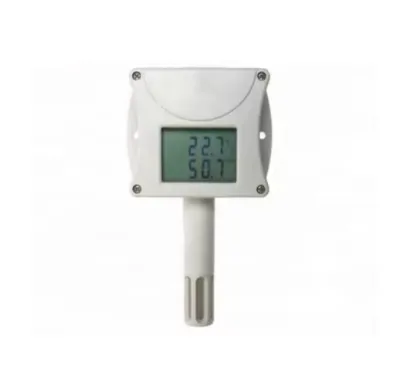
When sourcing wall-mounted analog temperature and humidity transmitters, buyers must first navigate a complex landscape of technical specifications that vary significantly between product models. The provided data indicates that while the core function remains consistent, the implementation details differ across specific model lines such as the RS-WS-2D, RS-WS-NO1-9L, and RS-WS-*-5 series. A critical observation is the diversity in physical dimensions; some units measure 147mm × 88mm × 41mm, while others are significantly larger at 80cm × 80cm × 225mm, or designed as probes with a length of 23.85cm and a diameter of 1.4cm. This variance suggests that the term "wall-mounted" applies to different form factors, ranging from compact DIN-rail compatible enclosures to large-scale flange-mounted sensors.
Power consumption and supply requirements are another area of variation. Most units in the observed dataset operate on a DC 1030V supply, with power consumption figures ranging from a low of 0.4W to a maximum of 1.2W. However, buyers must verify if the specific unit requires a specific voltage range or if it supports the broader 1030VDC standard. The output signal capabilities are equally diverse, with some models offering analog outputs like 420mA, 05V, or 0~10V, while others provide digital communication via RS485 (Modbus-RTU) or even Ethernet. This distinction is vital for integration into existing Building Management Systems (BMS) or Industrial IoT networks. The precision of these devices also varies; temperature accuracy is typically cited as ±0.4°C or ±0.5°C at 25°C, while humidity precision ranges from ±2%Rh to ±3.0%Rh.
Environmental Operating Ranges and Stability Metrics
The operational environment is a primary driver for selecting the correct transmitter. The observed data reveals a wide spectrum of operating temperatures and humidity ranges. Some models are rated for extreme conditions, with probe operating temperatures spanning from -40°C to +120°C, while the default range may be restricted to -40°C to +80°C. In contrast, other units are specified for a narrower range of -40°C to +60°C or -40°C to +50°C. Similarly, humidity ranges vary from 0%Rh to 100%Rh in high-capacity models to 0%Rh to 80%Rh in more standard industrial units.
Long-term stability is a crucial metric for maintaining data integrity over years of operation. The data indicates that high-quality units offer a long-term stability of ≤1%Rh per year for humidity and ≤0.1°C per year for temperature. This metric is often overlooked during initial procurement but is essential for applications requiring high-precision monitoring without frequent recalibration. Additionally, the circuit operating temperature and humidity must be considered separately from the probe's range. For instance, while a probe might withstand -40°C to +120°C, the internal circuitry may only function reliably between -20°C and +60°C with humidity up to 80%Rh. Buyers must ensure that the entire assembly, including the housing and internal electronics, is rated for the specific environmental conditions of the installation site.
Compliance, Certification, and Standard Verification
In the absence of explicit certification listings in the provided data, buyers must treat compliance as a verification step rather than an assumed attribute. The data references specific product standards related to dimensions, such as 147mm × 88mm × 41mm or 100 × 85 × 26 mm, but these are physical specifications rather than regulatory certifications. When evaluating suppliers, procurement teams should explicitly request documentation regarding EMC (Electromagnetic Compatibility) compliance, as one model explicitly mentions the adoption of an "EMC Antijamming Device." This feature is critical for industrial environments where electrical noise can corrupt analog signals.
Buyers should also verify adherence to international safety and quality standards, such as ISO 9001 for quality management or specific regional safety certifications for electrical equipment. The "Export Standard Plowood Case" mentioned in the data suggests that packaging meets certain logistics requirements, but it does not constitute a product certification. It is imperative to confirm that the supplier can provide test reports validating the claimed precision, response time, and stability figures. For example, the response time for humidity is noted as ≤8s under specific wind speed conditions (1m/s), but this performance must be validated under the buyer's specific installation conditions. Without explicit certification data in the source material, the procurement strategy must prioritize suppliers who can transparently share third-party test results and compliance documentation.
Cost Drivers and Pricing Dynamics
The observed price range for these devices spans from $2.2 to $1000 USD, a variance that reflects differences in technology, build quality, and functionality. Several factors drive these costs. First, the output signal type significantly impacts price; units with simple analog outputs (4~20mA) are generally more affordable than those with digital interfaces like RS485 or Ethernet, which require more complex internal processing. Second, the physical size and material construction play a role; larger units with flange installations or those designed for extreme temperature ranges (up to +120°C) command higher prices due to the specialized sensors and robust housing required.
Minimum Order Quantity (MOQ) is another critical cost driver, with observed ranges from 1 to 1000 units. For small-scale projects or prototyping, suppliers with low MOQs are essential, though they may carry a higher unit cost. Conversely, large-scale deployments can leverage economies of scale, but buyers must be aware that high MOQs might be required to access the lower end of the price spectrum. Customization is available for many models, which can increase costs and lead times. Features such as specific mounting configurations, custom cable lengths, or tailored calibration certificates will add to the base price. Buyers should also consider the total cost of ownership, including the potential need for recalibration or replacement if long-term stability is poor, rather than focusing solely on the initial purchase price.
Typical Applications and Installation Considerations
The versatility of these transmitters allows for deployment across various sectors, from HVAC systems to industrial process control. The "Typical Features" noted in the data, such as support for wall mounting and rail mounting, indicate suitability for control panels and wall-mounted enclosures in commercial buildings. The flange installation option suggests applications where the sensor needs to be mounted directly onto a duct or pipe, such as in industrial ventilation or manufacturing processes. The large dimensions of some models (80cm × 80cm × 225mm) might indicate specialized environmental chambers or large-scale monitoring stations rather than standard room sensors.
Installation considerations must align with the environmental ratings. For instance, in environments with high humidity or extreme temperatures, the probe's operating range must exceed the site conditions to ensure longevity. The response time of ≤8s for humidity is particularly relevant for applications requiring rapid detection of changes, such as in cleanrooms or pharmaceutical storage. Buyers should also evaluate the power supply requirements; a 10~30V DC supply is standard, but the specific power consumption (0.4W vs. 1.2W) may influence the choice of power supply units or the need for power over Ethernet (PoE) solutions if the model supports Ethernet output. Proper mounting is essential to avoid thermal interference; wall-mounted units should be installed away from direct sunlight or heat sources to maintain accuracy.
Supplier Evaluation and Quality Control Protocols
Evaluating suppliers for these components requires a rigorous approach to quality control. Given the variability in precision and stability claims, buyers should request detailed calibration certificates and traceability data for each unit. The "Export Standard Plowood Case" indicates a level of packaging professionalism, but it is not a substitute for quality assurance. Buyers should verify the supplier's ability to provide consistent performance across batches, as the data shows variations in precision (±0.4°C vs. ±0.5°C) and stability metrics.
A robust quality control protocol should include pre-shipment testing to verify output signals, power consumption, and environmental ratings. For analog transmitters, checking the linearity of the 420mA or 010V signals is essential. For digital units, verifying Modbus-RTU communication integrity is necessary. Buyers should also assess the supplier's after-sales support, including the availability of spare parts and technical assistance for troubleshooting. The "Customized" attribute suggests that suppliers should be capable of adapting products to specific needs, but this capability must be backed by a proven track record of successful customizations.
Long-Term Procurement and Lifecycle Management
Long-term procurement strategies for wall-mounted analog transmitters must account for the lifecycle of the equipment. The long-term stability figures (≤1%Rh/Y, ≤0.1°C/Y) suggest that these devices are designed for multi-year service, but regular maintenance and recalibration are necessary to maintain accuracy. Buyers should plan for periodic calibration intervals, typically annually or bi-annually, depending on the criticality of the application. The availability of spare parts and the supplier's commitment to product continuity are also vital; a model that is discontinued after a few years can disrupt operations and force costly replacements.
Furthermore, the evolution of communication protocols should be considered. While RS485 and analog outputs are currently standard, the presence of Ethernet-capable models indicates a trend toward digital integration. Buyers should future-proof their investments by selecting suppliers who offer upgrade paths or compatible models that support newer communication standards. The modular nature of some designs, such as the separation of the probe and the circuit, may facilitate easier maintenance and component replacement. Ultimately, a successful procurement strategy balances initial cost with long-term reliability, ensuring that the selected transmitters provide accurate data throughout their operational lifespan without frequent intervention.
FAQs
What power supply voltage do these transmitters require?
These transmitters typically require a DC 10~30V power supply. Some specific models operate within this range with a maximum power consumption of 0.4W, while others may consume up to 1.2W depending on the output signal type selected.
How accurate are the temperature and humidity measurements?
Temperature precision is generally ±0.4°C at 25°C, while humidity precision ranges from ±2%Rh to ±3%Rh at 60%Rh and 25°C. These accuracy levels ensure reliable data for most industrial and environmental monitoring applications.
Which output signals are supported by these devices?
Supported output signals include RS485 (Modbus-RTU), 4~20mA, 0~5V, and 0~10V. Some advanced models also offer Ethernet connectivity, allowing flexible integration with various Building Management Systems and industrial networks.
Can these units be customized for specific mounting needs?
Yes, customization is available for these transmitters. They typically support wall mounting and rail mounting, with some models featuring flange installation options to accommodate different installation environments and structural requirements.
What is the operating temperature range for the probe?
The probe operating temperature range is typically -40°C to +120°C, with a default setting of -40°C to +80°C. The internal circuitry usually operates reliably between -20°C and +60°C with humidity up to 80%Rh.
How long does the device maintain stability over time?
High-quality units offer long-term stability of ≤1%Rh per year for humidity and ≤0.1°C per year for temperature. This ensures consistent performance and reduces the frequency of required recalibration for critical monitoring tasks.
What packaging is used for exporting these transmitters?
Products are typically packed in wooden cases or export standard plowood cases. This packaging ensures safe transport and protection against damage during shipping, meeting standard logistics requirements for international delivery.